


The Challenge
Vibe marketing is a 2025-era, AI-driven branding strategy that prioritizes creating an immediate emotional feeling around a brand rather than directly promoting product features. But for indie beauty brands with 3–15 person marketing teams, existing tools force a choice: expensive agencies that get the brand right, or generic AI tools that move fast but sound like everyone else.

Emotional Resonance at scale
Role
Design Strategist
Focus
Research, Strategy, Product Design, Execution
Timeline
Jan 2026-March 2026
Tools
Excel, Figma, Miro
10
Weeks
78
Survey Responses
16
Interviews
Overview
Indie beauty brands have strong founder vision, but no system to turn that vision into consistent, emotionally resonant marketing. As teams grow, the original "vibe" dilutes across campaigns, content, and touchpoints.
I designed Vaible Studios: a vibe marketing operating system that combines a facilitated brand identity workshop with an AI-powered campaign engine — so lean teams can create emotionally grounded content at speed without losing their brand's soul.
Operationalizing Vibes
Research
A mixed-methods approach balancing depth, scale, and speed across primary and secondary research.
Market Research
Survey
Interviews
Market research
US beauty market composition
Total market size
$109B
Indie beauty brands


Established beauty brands
US beauty market growth: Indie vs Big beauty brands

Shifting consumer preferences toward brands offering:
- Unique product offerings
- Authenticity
- Direct community engagement
US beauty market size
$3.8B
TAM
TOM
$55M
SOM
$2M
Total Addressable Market (TAM)
$32 B indie beauty × 12% marketing spend. 25% relevant to content, social, brand voice, community.
Total Obtainable Market (TOM)
~2,500–3,000 brands fit the maturity + budget profile out of ~8,000–10,000 indie beauty brands in the US.
Serviceable Obtainable Market (SOM)
2–3% penetration in first 2–3 years via founder-led sales + referrals.
Marketing Spend Assumption
Industry average marketing spend for indie brands:
-
~10–15% of revenue
Conservative midpoint
-
12% marketing spend
TAM (Marketing Spend Pool): $32B × 12% ≈ $3.8B
Customer: US-based indie beauty brands
-
10–50 employees
-
Gen Z–focused
-
Small marketing teams
-
$1M–$6M annual marketing spend
Competitive Landscape
I analyzed five competitors across the vibe marketing space using Blue Ocean Strategy's ERRC framework.

Averi AI
What They Solve
Brand voice + content generation
What They Miss
No cultural relevance or audience feedback loops

Vibelets
What They Solve
Paid ad automation at scale
What They Miss
No organic brand building or loyalty

Winnin
What They Solve
Cultural trend intelligence
What They Miss
No content creation or brand voice definition

VaynerMedia
What They Solve
Localized creative at global scale
What They Miss
No content creation or brand voice definition

Resonance Studio
What They Solve
Cultural trend intelligence
What They Miss
No content creation or brand voice definition
The white space:
No one integrates brand essence definition, cultural listening, AI-enabled execution, and affordability — all in one system built for indie beauty.
Survey

n = 78
The survey targeted Gen Z beauty consumers aged 18-24 (76% of respondents), with 71% spending $0-$25/month on beauty and 76% having purchased in the last 90 days. They buy primarily at drugstores/Target/Walmart (62%), Amazon (53%), Ulta (38%), and Sephora (35%).
Insights :


1. Scroll-stopping is driven by aesthetics and a relatable hook, not brand story
Indie brands have to signal the vibe and make it personally relevant, fast


3. “Distinct” = clear purpose + cohesive look + real customer stories
Differentiation isn’t just “cute packaging.” It’s the trio of:
- Recognizable system (visual + voice),
- Sharp positioning (what it’s for),
- Customer proof (people like me using it).
The core implication:
Vibe isn't the strategy. Vibe is the wrapper for proof.

2. Trust is socially constructed
53% flag too many ads as an untrust trigger, and validation happens through Reddit, reviews, and comment sections, not brand claims.

4. Creator influence is fragile
#ad" is a trust tax, and the winning creator content is longitudinal and repeat-use, not hype.
Interview
Interviews explored how brands build emotional identity, where it breaks at scale, and how Gen Z defines authenticity. Ten Gen Z consumers revealed what makes a brand feel emotionally resonant versus performative. Six industry experts — indie beauty founders, marketers, and brand strategists exposed the operational reality of trying to maintain brand soul with lean teams.
10 Gen Z Consumers
6 Industry Experts
Insights :

1. Emotional brand identity is a strategic asset
Brands are remembered for how they feel, not what they claim.

3. Brand vibe must stay consistent across fragmented platforms
Gen Z experiences brands holistically
The Gaps:

2. Cultural relevance requires both speed and sensitivity
Fast participation without sensitivity feels performative.

4. Reducing cognitive load unlocks creative expression
When teams are overwhelmed by execution, brand-building becomes reactive and shallow
Brand essence is not operationalized
Existing tools don't fit small team realities
trust-building is disconnected from execution
Redefining opportunity:
To help indie beauty brands translate their brand vibe into a repeatable, trust-building marketing system that supports small teams in creating emotionally resonant and credible campaigns at speed.
Business Model


Strategic Solution


Product and Service architecture
The first vibe marketing operating system designed specifically for indie beauty brands to scale emotional resonance, not just content output.


Vibe Identy Workshop
A facilitated session that converts founder intuition into a structured brand framework. It produces the Vibe Identity Book — emotional north star, brand DNA, voice guardrails, and product-to-emotion mapping which becomes the source of truth for all AI-generated content.

Vaible Studios
An AI-powered marketing platform trained on the brand's Vibe Identity Book. It combines a Campaign Creation Engine that generates on-brand concepts, copy, visual direction, and experiment plans with a built-in Vibe Dashboard that tracks emotional resonance, audience sentiment, and brand consistency, feeding insights back into the system so it gets sharper over time.
Vaible runs as a closed-loop system. The Vibe Identity Workshop defines the brand's emotional core and produces a Vibe Identity Book — the source of truth. That book feeds into the AI Campaign Creation Engine, which generates on-brand campaign concepts, copy, and visual direction. Content gets tested as micro-experiments across channels, and performance signals flow into the Vibe Dashboard, which tracks emotional resonance, not just engagement. Those insights feed back into the framework, so the system gets sharper with every cycle.
%20(1).jpeg)
Vibe Analytics workshop
A facilitated session that converts founder intuition into a structured vibe framework: emotional north star, brand DNA, voice guardrails, product-to-emotion mapping, and approved vocabulary.


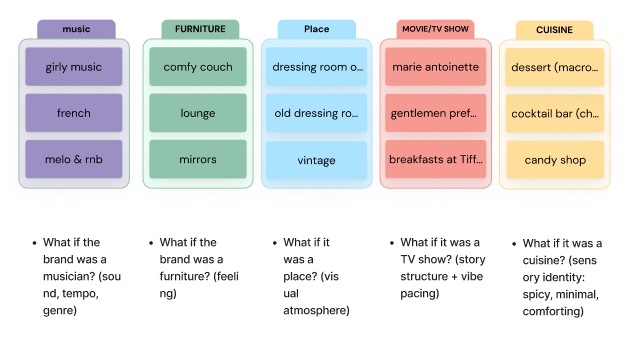
Emotional North Star (dream and nightmare framing)
Brand DNA: 3 core values, each tied to behavior and proof
Personality range and voice guardrails (do / don't / taboos)
A Vibe Moodboard in words, AI-ready
Product-to-emotion mapping for hero products


Strategy-first, not prompt-first
AI generates content trained on a structured brand framework, not generic prompts. Every output traces back to the brand's defined voice, values, and visual language.

Closed-loop system
Essence → Creation → Feedback → Refinement
Performance data feeds back into the brand framework, so the system gets sharper over time.

Built for indie beauty brands
Workflows designed for 3-15 person teams with $1M-$6M marketing budgets and founder-led decision-making.
Vaible Studios
Vaible Studios is a vibe marketing operating system for indie beauty brands. It combines vibe identity workshop with a subscription-based AI campaign engine and analytics dashboard, giving lean marketing teams a single system to define their brand's emotional core, create on-brand content at speed, and measure whether it actually resonates, all without agency dependency.
Campaign concepts
Experiment Plans
Tool handoff

Visual direction
Vibe Dashboard

Workshop output :
Through a series of focused activities, including an emotional north star exercise, brand DNA mapping, and "What If" metaphor prompts, the workshop surfaces how a brand feels, not just what it sells.
The output is a Vibe Identity Book: a documented set of brand values, tone guardrails, sensory cues, and product-to-emotion mappings that feeds directly into the AI campaign engine.
User Testing
To validate the model, I piloted the full Vaible Studios offering with Lalka Beauty Co., a boutique beauty brand and makeup studio in Savannah's Historic Victorian District founded by a veteran film/TV makeup artist.


The brand's reality:
Average order of $60, monthly marketing budget of roughly $1,000, a 50/50 split between locals and tourists, no social media strategy, and no traction with Gen Z.
What we did: Conducted the Vibe Identity Workshop, synthesized and set up their brand vibe, which consists of 1) Brand voice 2)Brand DNA 3)Brand assets 4)Visual moodboard 5) Product to emotion mapping 6) Buiness aspects

We then built a custom AI campaign engine using Lalka's Vibe Identity Book as the source of truth, prompted through Google Gemini custom Gem to act as a full marketing team constrained by the brand's voice, DNA, visual moodboard, and product-to-emotion mapping. The engine generated campaign concepts, copy, and visual direction for a Women's Day campaign. We published one scroll post and three supporting stories.


Impact


The vibe-based content outperformed Lalka's typical posts by a wide margin, driving higher interaction, shareability, and new audience reach from just one post and three stories. A single founder with no marketing team went from undefined brand identity to a live, on-brand campaign within the pilot window, and every piece of content stayed true to the vibe defined in the workshop.
Financials
Pricing
Vibe Identity Workshop
$1500 one time
5 year Trajectory
Investment ask

$150k
to productize, acquire early customers, and build GTM engine
Break even

18
Active subcriptions
Projected 5-year ROI

2.8x
on $150K

Vibe Studios Subscription
$450/month per brand

Go to market
Start narrow, prove value, scale through partners

Phase 1 (0-6 months)
Founder - led outreach
5 pilots + 2 case studies
Phase 2 (6-18 months)
Partner with freelance social managers + incubators
12–30 brands

Phase 3 (18-36 months)
Referral loops + category authority
Lower CAC, more inbound
Check out the foundation document to know more about the design process, by using right/left arrow key or flipping through pages

Reflection
This project pushed me to operate across research, strategy, product design, and real-world execution, all as a solo practitioner. Three things I'd carry forward:

Research earns the strategy
The survey and interview insights didn't just inform the solution — they became the pitch. Every strategic decision traces back to what Gen Z consumers and indie founders actually said.

Test with real stakes
Piloting with Lalka Beauty Co. forced the model to survive contact with a real business — real budgets, real constraints, real content published to real followers.

Systems over artifacts
The value isn't the workshop or the AI tool alone — it's the closed loop between brand identity, content creation, and audience feedback. That's what makes it an operating system, not a one-off deliverable.